 CalcRig
· CalcRig Team · 4 min read
Residential Electrical Load Calculation: NEC Article 220 Guide
How to calculate the electrical service load for a residential panel — the NEC Article 220 standard method and optional method. Required for service sizing and permit applications.
Sizing a residential electrical service starts with a load calculation. Undersized service trips breakers and fails inspection. Oversized service wastes money on excess panel capacity. NEC Article 220 provides two methods — here’s how to use each one.
The Two Methods
Standard Method (NEC 220.82 is for optional; standard uses 220.40–220.60): Calculates loads individually, applies demand factors per NEC tables.
Optional Method (NEC 220.82): Simplified single-family dwelling calculation. Widely accepted for permits. Most residential electricians use this.
Optional Method — NEC 220.82
Step 1: General Load
Calculate at 33 VA per square foot of floor area (for the first calculation segment):
Wait — the Optional Method uses a different approach. Here’s how it actually works:
First 10 kVA of load: at 100% Remaining load: at 40%
Total load = first 10 kVA + (remaining kVA × 40%)
But first, what goes into “total load”?
Step 1: Tabulate All Loads
General lighting and receptacle load: 3 VA per sq ft (NEC 220.12) for the floor area of the dwelling.
For a 2,000 sq ft house: 2,000 × 3 = 6,000 VA
Small appliance circuits: 1,500 VA each × 2 required circuits minimum = 3,000 VA
Laundry circuit: 1,500 VA (NEC 220.52)
Fixed appliances: Nameplate VA (or watts) for:
- Electric range: nameplate or 8,000 VA minimum
- Dryer: nameplate or 5,000 VA minimum
- Dishwasher: nameplate (typical 1,200–1,800 VA)
- Microwave: nameplate
- Water heater: nameplate
- Disposal: nameplate
- Any other fixed motor load
Heating or cooling (largest of the two): Take the larger of:
- Air conditioning compressor + air handler
- Electric heating strips (total) This is always 100% — no demand factor.
Step 2: Apply the Demand Factor
Add up all general loads (everything except HVAC):
Example house — 2,000 sq ft:
- General lighting: 6,000 VA
- Small appliance circuits: 3,000 VA
- Laundry: 1,500 VA
- Electric range: 8,000 VA
- Dryer: 5,000 VA
- Dishwasher: 1,200 VA
- Water heater: 4,500 VA
- Subtotal: 29,200 VA
Apply Optional Method demand factor:
- First 10,000 VA × 100% = 10,000 VA
- Remaining 19,200 VA × 40% = 7,680 VA
- Subtotal after demand = 17,680 VA
Add HVAC (100%):
- 5-ton AC compressor + air handler = 8,400 VA
- Total = 26,080 VA
Step 3: Calculate Service Current
Single-phase 240V service:
I = Total VA ÷ Voltage
I = 26,080 ÷ 240 = 108.7 A
Round up to standard service size: 125A minimum — but most residential new construction uses 200A for future capacity.
Standard Method Overview (NEC 220.40–220.60)
The standard method calculates loads room-by-room and applies specific demand factors from NEC tables:
Lighting demand factors (NEC Table 220.42):
| Portion of Load (VA) | Demand Factor |
|---|---|
| First 3,000 VA | 100% |
| 3,001 to 120,000 VA | 35% |
| Over 120,000 VA | 25% |
Appliance demand factors (NEC 220.53): For 4 or more fixed appliances (excluding ranges, dryers, AC), apply 75% demand factor to the combined load.
Range demand (NEC Table 220.55): Ranges 12 kW or less: 8,000 VA demand. For ranges over 12 kW, add 5% per kW over 12 kW.
Dryer demand (NEC 220.54): 5,000 VA or nameplate, whichever is larger. For 4 or more dryers, use Table 220.54.
The standard method is more precise for unusual loads and is required when the optional method isn’t applicable (multi-family, for example).
Service Entrance Conductor Sizing
Once you have the demand load in amperes, size service entrance conductors per NEC 310.15:
| Service Amperage | Copper (THW/THWN-2) | Aluminum (USE-2) |
|---|---|---|
| 100A | 4 AWG | 2 AWG |
| 125A | 2 AWG | 1/0 AWG |
| 150A | 1 AWG | 2/0 AWG |
| 200A | 2/0 AWG | 4/0 AWG |
Note: Service entrance conductors aren’t derated even when multiple are run together, per NEC 310.15(B)(3)(a).
Common Additions That Require Service Upgrade
EV charger: Level 2 EVSE at 48A continuous requires 60A circuit (48A × 125% = 60A). On a 200A service with modern load profile, typically manageable. On 100A service, may require upgrade.
Hot tub/spa: Typical 50A–60A dedicated circuit at 240V.
Addition with electric heat: Electric resistance heating adds significant load. A 10 kW baseboard heater adds 10,000 VA at 100% to the calculation.
EV Load Management
NEC 220.57 (added 2023) allows EV charging loads to use 25% demand factor if managed by an energy management system (EMS) that prevents demand exceeding service capacity. This reduces the service size required for homes adding EV chargers without upgrading service.
How CalcRig Handles This
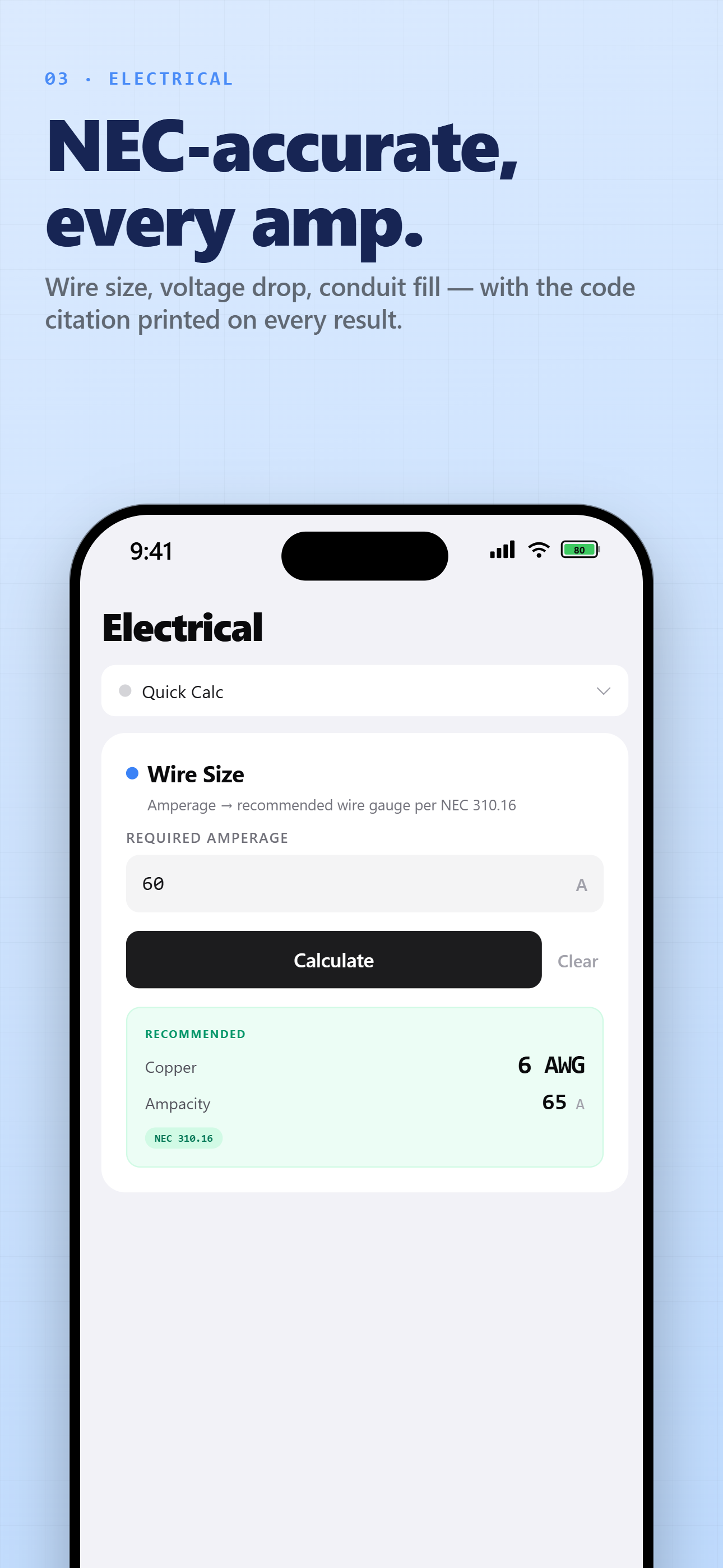
CalcRig’s load calculator implements both the Optional Method (NEC 220.82) and the Standard Method:
- Enter floor area, fixed appliances, HVAC tonnage
- Get the calculated demand load in VA and amps
- See the minimum service size recommendation
- NEC 220 section cited with every result
Related trade guides: