 CalcRig
· CalcRig Team · 3 min read
Duct Sizing for HVAC: The ASHRAE Equal Friction Method Explained
How to size supply and return ducts correctly using the equal friction method — the ASHRAE standard approach used by HVAC professionals.
Undersized ducts restrict airflow, cause pressure imbalances, and make systems work harder than they should. Oversized ducts waste materials and money. The ASHRAE equal friction method gets you to the right size systematically.
What is the Equal Friction Method?
The equal friction method sizes ducts so that friction loss per unit length is equal throughout the duct system. The target is typically 0.08–0.10 in. wg per 100 feet of duct for residential work, and up to 0.10–0.15 in. wg/100 ft for commercial systems.
This approach:
- Balances the system naturally (less need for manual damper adjustment)
- Is straightforward to calculate
- Is recognized by ASHRAE fundamentals as the standard residential/light commercial method
Step 1: Calculate the Heating or Cooling Load
Before sizing ducts, you need to know how much air each room requires. This comes from a Manual J load calculation, which accounts for:
- Room area and ceiling height (volume)
- Insulation R-values
- Window U-values and solar heat gain
- Infiltration rate
- Occupancy and internal gains
The output is BTU/hr (heating) or tons (cooling). From there, you calculate CFM (cubic feet per minute):
CFM = BTU/hr ÷ (1.1 × ΔT)Where ΔT is the temperature difference between supply air and room temperature (typically 20–25°F for heating, 15–20°F for cooling).
Example: 12,000 BTU/hr cooling load, ΔT = 20°F:
CFM = 12,000 ÷ (1.1 × 20) = 545 CFMStep 2: Size the Main Trunk
The main trunk carries total system CFM. Using an ASHRAE duct sizing chart (or friction chart) at your target friction rate:
At 0.10 in. wg/100 ft:
- 500 CFM → approximately 10” round duct
- 1,000 CFM → approximately 14” round duct
- 2,000 CFM → approximately 18” round duct
For rectangular ducts, use equivalent diameter:
De = 1.30 × (a × b)^0.625 / (a + b)^0.25Where a and b are duct dimensions in inches.
Step 3: Size Branch Ducts
Each branch serves a specific room. Size each branch based on its CFM requirement at the same target friction rate.
Example branch run:
- Room load: 6,000 BTU/hr cooling
- CFM needed: 6,000 ÷ (1.1 × 20) = 273 CFM
- At 0.10 in. wg/100 ft: approximately 8” round duct
Step 4: Check Velocity
Even after sizing for friction, verify duct velocity is acceptable:
- Supply ducts (main trunk): 600–900 FPM maximum for residential (noise threshold)
- Supply ducts (branches): 400–600 FPM
- Return ducts: 400–600 FPM
Velocity formula:
FPM = CFM ÷ Duct Area (sq ft)A 10” round duct has area = π × (5/12)² = 0.545 sq ft. At 500 CFM: 500 ÷ 0.545 = 917 FPM — slightly over the residential limit. Upsize to 12” (0.785 sq ft = 637 FPM ✓).
Common Sizing Mistakes
1. Skipping the load calculation. Sizing ducts by rule of thumb (“1 ton per 400 sq ft”) without a proper Manual J leads to systems that can’t meet design conditions.
2. Ignoring fittings. Each elbow, tee, and transition adds friction. Account for equivalent lengths: a 90° elbow can add 5–20 feet of equivalent straight duct.
3. Undersizing returns. Return ducts are just as important as supply. Undersized returns create negative pressure in the living space, pulling air through gaps and leaks.
4. Using the wrong friction rate. 0.08–0.10 in. wg/100 ft is correct for most residential systems. Using 0.05 gives you oversized ducts; 0.15 gives undersized ones.
CalcRig HVAC Calculators
CalcRig handles duct sizing based on ASHRAE methods:
- Enter your CFM and target friction rate
- Get the recommended round duct diameter
- See the velocity at that size to verify it’s within limits
- ASHRAE reference cited with every result
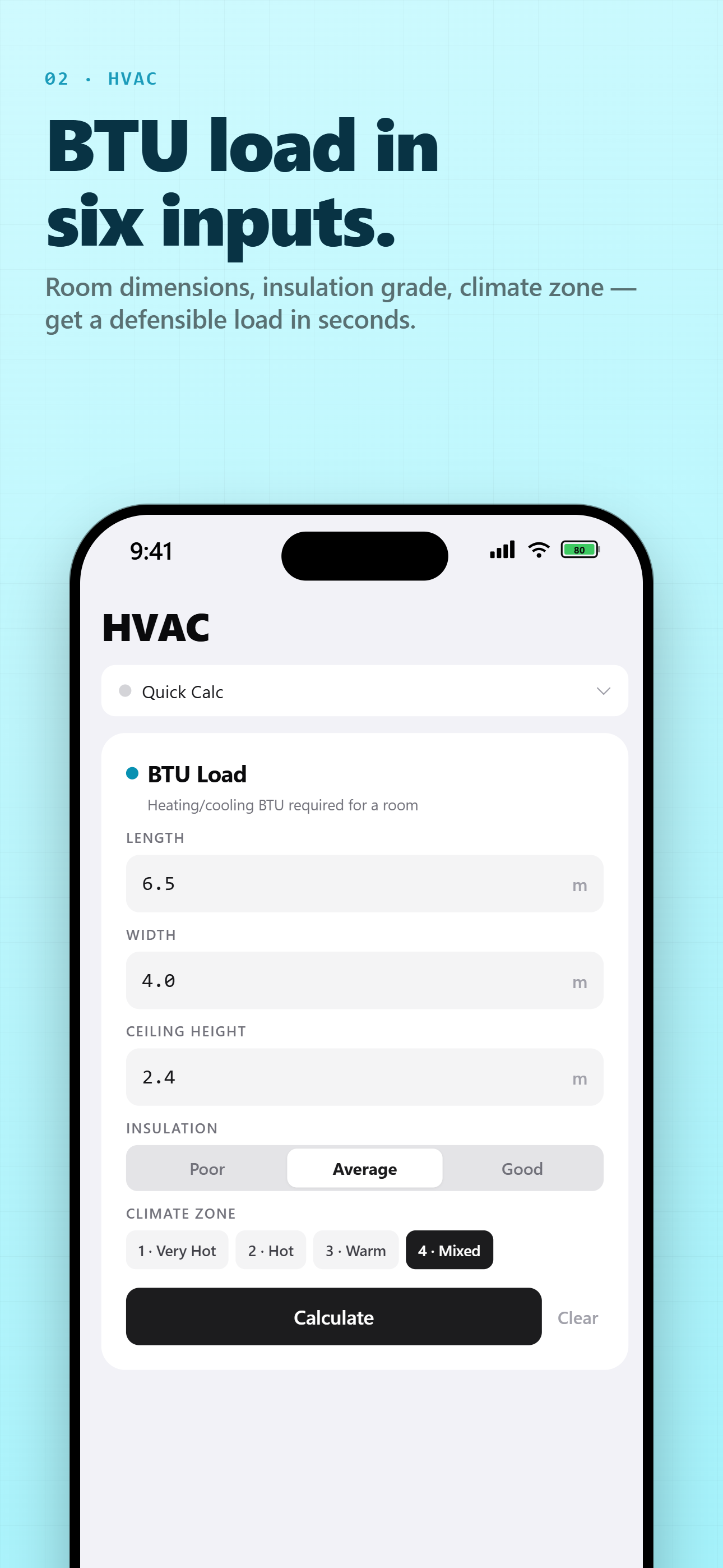
The heat load and BTU calculators work alongside duct sizing so you can go from room dimensions to duct size in a single workflow.
Related trade guides: