 CalcRig
· CalcRig Team · 4 min read
Manual J Heat Load Calculation: HVAC Sizing Guide for Technicians
How to calculate heating and cooling loads using Manual J — the ACCA standard method. Covers the inputs, the math, and why rule-of-thumb sizing fails.
Manual J is the ACCA (Air Conditioning Contractors of America) standard for calculating residential heating and cooling loads. It’s required by most building codes for new construction and HVAC replacement, and it’s what separates properly sized equipment from oversized systems that short-cycle and fail early.
Why “Rules of Thumb” Fail
The old rule — “1 ton per 400–600 square feet” — doesn’t account for:
- Ceiling height
- Insulation levels
- Window area and orientation
- Climate zone
- Infiltration rate
- Internal gains (people, appliances)
Result: a 2,000 sq ft house in Phoenix needs completely different equipment than the same footprint in Minneapolis. Rule-of-thumb sizing leads to oversized equipment in mild climates (short-cycling, poor humidity control) and undersized equipment in extreme climates.
The Manual J Inputs
A proper Manual J requires these inputs for each room or zone:
Envelope Data
- Floor area and ceiling height (conditioned volume)
- Wall construction and insulation R-value — R-13 batt vs R-21 spray foam changes the calculation significantly
- Ceiling/roof insulation R-value — ceiling is often the largest heat gain/loss path
- Floor type — slab, crawl space, or conditioned basement; each loses heat differently
Window and Door Data
- Window area by orientation (N/S/E/W matter — south-facing windows gain much more solar heat in winter and summer)
- Window U-value (thermal conductance) — the lower the U-value, the better. Double-pane = ~0.48, triple-pane = ~0.25
- SHGC (Solar Heat Gain Coefficient) — low-SHGC glass blocks solar heat gain; useful in hot climates
Climate Data
- Outdoor design temperatures — from ASHRAE Fundamentals, by climate zone. For example: Atlanta design day = 95°F cooling / 22°F heating
- Indoor design conditions — typically 75°F/50% RH for cooling, 70°F for heating
Infiltration
- ACH (Air Changes per Hour) — how much outside air leaks into the house
- Tight construction (new, well-sealed): 0.25–0.35 ACH
- Average existing home: 0.5–1.0 ACH
- Older leaky home: 1.0+ ACH
Internal Gains (Cooling Only)
- Occupants: 250 BTU/hr sensible + 200 BTU/hr latent per person
- Lighting: 3.4 BTU/hr per watt (LED significantly lower than incandescent)
- Appliances: kitchen loads can add 1,200–2,500 BTU/hr
The Core Calculation
For each surface (wall, ceiling, window, floor), the heat flow is:
Q = U × A × ΔTWhere:
- Q = heat transfer (BTU/hr)
- U = thermal transmittance (1 ÷ R-value)
- A = area (sq ft)
- ΔT = temperature difference (indoor – outdoor design temp)
Example: 200 sq ft exterior wall, R-13 insulation, -10°F outdoor design, 70°F indoor:
U = 1 / 13 = 0.077
ΔT = 70 - (-10) = 80°F
Q = 0.077 × 200 × 80 = 1,232 BTU/hr
Repeat this for every envelope surface, add infiltration losses, and sum everything for total heating load.
Converting BTU/hr to Tons (Cooling)
Equipment capacity is specified in tons:
1 ton = 12,000 BTU/hrA house with a 36,000 BTU/hr cooling load needs a 3-ton system.
The most common sizing mistake: rounding up aggressively. A 3.2-ton load doesn’t need a 4-ton system — the 3-ton equipment runs longer cycles and controls humidity better. Oversizing is worse than slight undersizing.
Latent vs Sensible Load
Total cooling load has two components:
Sensible load — temperature (dry air, walls, windows): accounts for roughly 60–75% of total cooling load in most climates.
Latent load — humidity (moisture removal): higher in humid climates (Southeast US, tropical) and from high-occupancy spaces.
The equipment’s SHR (Sensible Heat Ratio) must match the building’s load ratio. Oversized equipment cools the air quickly before removing enough moisture — the room feels cold but clammy.
ASHRAE Standards Behind Manual J
Manual J is published by ACCA and references:
- ASHRAE Standard 183 — peak cooling and heating load calculations
- ASHRAE Fundamentals — design weather data, materials properties
- ASHRAE 62.2 — ventilation requirements (which add latent load)
Most building codes (IRC, IBC) require Manual J for new construction HVAC sizing.
Simplified Calculation for Field Estimates
When you need a fast field estimate (not for final permits):
- Estimate envelope loss/gain: 15–30 BTU/hr per sq ft of conditioned space, depending on climate and insulation
- Adjust for windows: add 200 BTU/hr per sq ft of south-facing glass (cooling) or 100 BTU/hr (heating)
- Add infiltration: 0.5 ACH × volume × 0.018 × ΔT (for heating)
- Add internal gains (cooling only): 400 BTU/hr per occupant
This won’t pass a permit, but it gets you within ±15% for a quick equipment recommendation.
How CalcRig Handles This
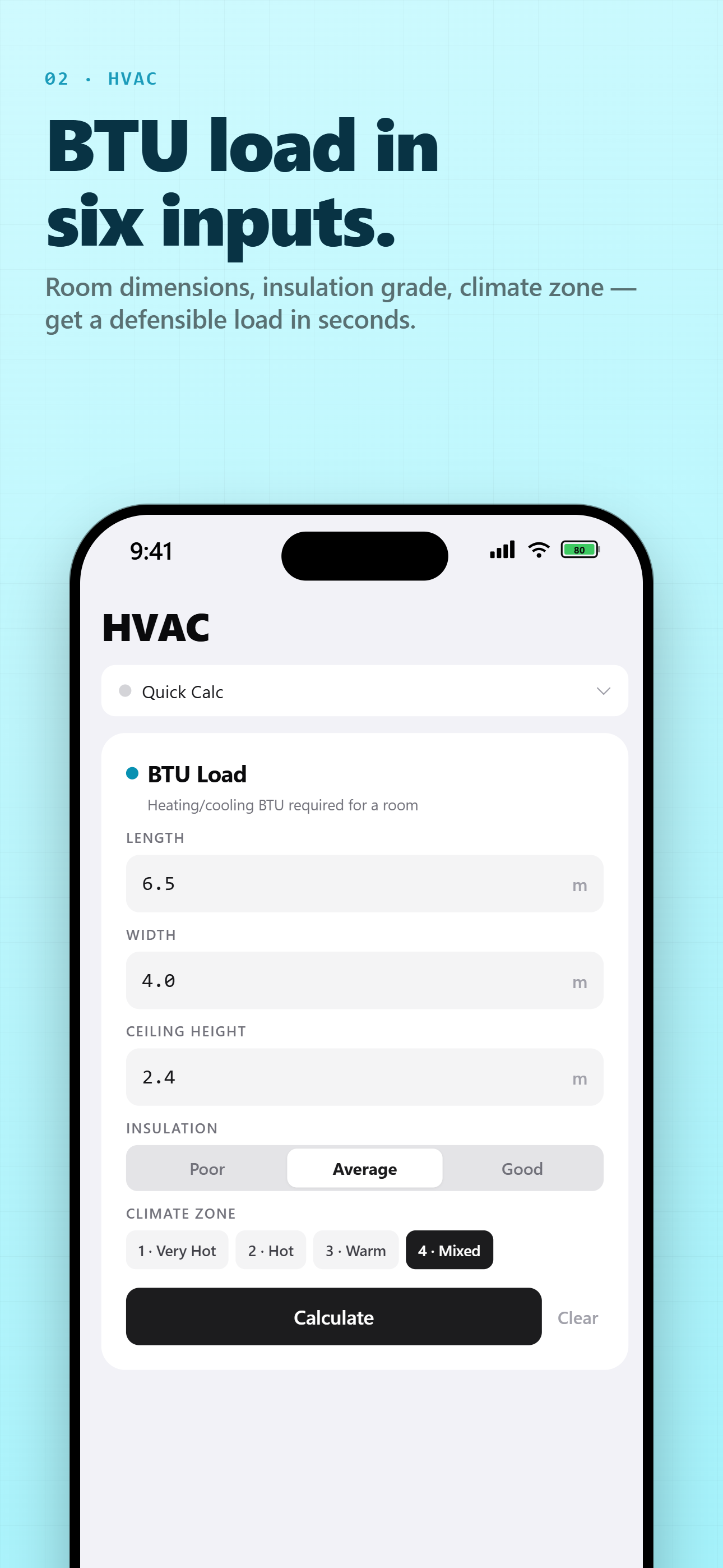
CalcRig’s heat load calculator handles the core Manual J inputs:
- Enter conditioned area, ceiling height, and insulation levels
- Specify window area and orientation
- Select climate zone for design temperatures
- Get the heating and cooling loads in BTU/hr and required tons
Every result shows the ASHRAE reference and the formula used — so you can explain the calculation to a homeowner or submit it with a permit application.
Related trade guides: