 CalcRig
· CalcRig Team · 3 min read
How to Calculate Concrete for Footings, Slabs, and Columns
Step-by-step concrete volume calculations for common pours — footings, slabs, walls, and columns. Includes waste factor guidance and ordering tips.
Ordering the wrong amount of concrete is one of the most expensive mistakes in construction. Too little means a second delivery charge and a cold joint. Too much means you’re paying for waste. Here’s how to get the numbers right.
Concrete is Sold by the Cubic Yard
Everything starts with volume in cubic yards (CY). The formula:
Volume (CY) = (Length × Width × Thickness) ÷ 27The ÷ 27 converts cubic feet to cubic yards (1 CY = 27 CF).
Slab Calculations
Example: 20’ × 30’ slab, 4” thick:
Volume = (20 × 30 × 0.333) ÷ 27 = 200 CF ÷ 27 = 7.41 CYAdd 5–10% waste factor for spillage, low spots, and subgrade variance:
Order: 7.41 × 1.08 = 8.0 CY → round up to 8.5 CYTypical slab thicknesses:
- 4” — residential driveway, patio, sidewalk
- 5” — light commercial, parking
- 6” — heavy vehicle traffic, industrial
Footing Calculations
Continuous footings (for foundation walls):
Volume (CY) = (Width × Depth × Length) ÷ 27Example: 16” wide × 10” deep continuous footing, 80 linear feet:
Volume = (1.333 × 0.833 × 80) ÷ 27 = 88.8 CF ÷ 27 = 3.29 CYSpread footings (for columns/posts):
Volume (CY) = (L × W × D) ÷ 27Example: 4 footings, each 24” × 24” × 12” deep:
Each footing: (2 × 2 × 1) ÷ 27 = 0.148 CY
4 footings: 0.148 × 4 = 0.59 CY → order 0.75 CY minimum
Note: small pours under about 1 CY are usually better served by bags rather than a ready-mix truck.
Column and Pier Calculations
Round piers (Sonotubes):
Volume (CY) = π × r² × Height ÷ 27Example: 12” diameter, 4 feet deep:
r = 0.5 ft
Volume = 3.14159 × 0.25 × 4 ÷ 27 = 3.14 CF ÷ 27 = 0.116 CY per pier
For 6 piers: 0.116 × 6 = 0.70 CY. Add 10% waste: order 0.77 CY.
Square columns:
Volume (CY) = Side² × Height ÷ 27Wall Calculations
Poured concrete walls:
Volume (CY) = (Length × Height × Thickness) ÷ 27Example: 40’ long × 8’ tall × 10” thick foundation wall:
Volume = (40 × 8 × 0.833) ÷ 27 = 266.7 CF ÷ 27 = 9.88 CYDon’t subtract for door openings unless they’re large — the rebar cage and pour complexity often means you’ll use the extra anyway.
Waste Factors by Pour Type
| Pour Type | Waste Factor |
|---|---|
| Slabs (flat, good subgrade) | 5–7% |
| Slabs (rough subgrade, grade changes) | 8–12% |
| Walls | 5–8% |
| Footings | 5–10% |
| Round piers | 10–15% |
When in doubt, add 10%. The cost of a half-yard overage is far less than a second truck.
Ordering Tips
- Minimum order charges: Most ready-mix suppliers have a minimum (often 1 CY or a short-load fee). For small pours, pre-mix bags may be cheaper.
- Specify PSI: Standard residential is 3,000 PSI. Driveways often spec 4,000 PSI for durability. Ask your engineer if in doubt.
- Air entrainment: Required in freeze-thaw climates — specify 5–7% air content.
- Slump: Request 4–5” slump for most pours. More than 6” means excess water and reduced strength.
- Timing: Have your crew and tools ready. Concrete waits for no one.
How CalcRig Handles This
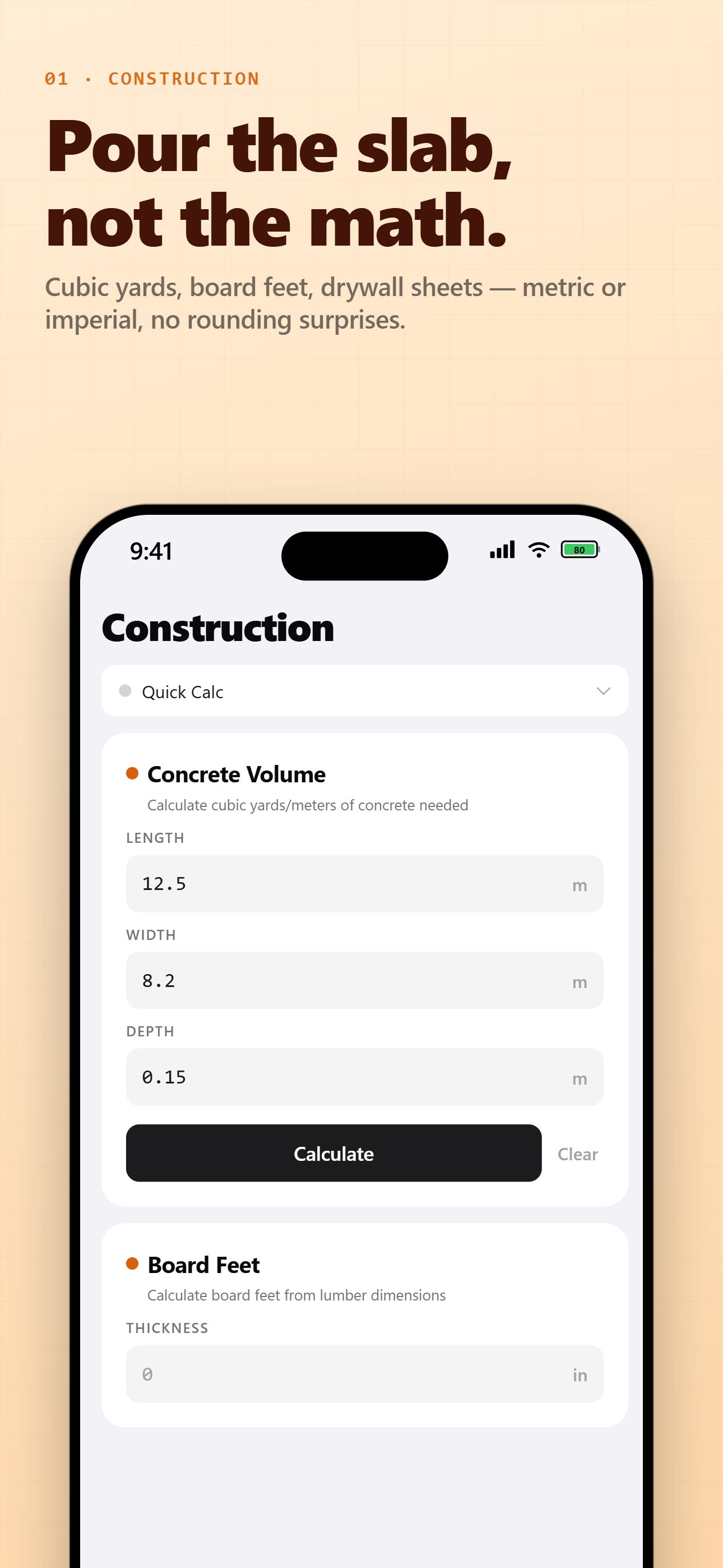
CalcRig’s concrete calculator handles all the shape types above:
- Slabs, footings (continuous and spread), columns, walls
- Applies your specified waste factor automatically
- Returns cubic yards, cubic feet, and number of 60 lb or 80 lb bags equivalent
- Works offline — no signal needed at the job site
Related trade guides: