 CalcRig
· CalcRig Team · 3 min read
Wire Sizing and Voltage Drop: What Every Electrician Needs to Know
A practical guide to NEC-compliant wire sizing and voltage drop calculations for residential and commercial work — with the exact formulas used in CalcRig.
Wire sizing and voltage drop are the two calculations electricians run on almost every job. Getting them wrong means failed inspections, tripped breakers, and in the worst case, fires. Here’s how to do them correctly — and how CalcRig automates the NEC lookups that slow you down.
Wire Sizing: The NEC 310.15 Basics
Wire size is determined by ampacity — the maximum current a conductor can carry continuously without exceeding its temperature rating. NEC Table 310.15(B)(16) is the go-to reference for most residential and commercial work.
Key inputs:
- Breaker/load amperage
- Conductor material (copper vs aluminum)
- Conduit type (PVC, EMT, free air)
- Temperature rating (60°C, 75°C, 90°C)
- Number of current-carrying conductors (derating applies at 4+)
Example: A 30A circuit in EMT conduit, copper conductors, 75°C rated equipment:
- NEC 310.15(B)(16) at 75°C: 10 AWG copper = 35A ampacity
- 10 AWG is the minimum — size up if voltage drop requires it
Derating for Multiple Conductors
When you have 4–6 current-carrying conductors in a single conduit, NEC 310.15(C)(1) requires an 80% derating factor. 7–9 conductors: 70%. 10–20: 50%.
This is where many calculations go wrong. A circuit that’s adequately sized for ampacity alone can fail the derating check.
Voltage Drop: The 3% and 5% Rules
NEC doesn’t mandate a maximum voltage drop — but NEC 210.19(A) informational note recommends:
- 3% maximum for branch circuits
- 5% maximum for feeder + branch circuit combined
Most inspectors and engineers treat these as requirements in practice.
The formula:
VD = (2 × K × L × I) / CMWhere:
- VD = Voltage drop (volts)
- K = Resistivity constant (12.9 for copper, 21.2 for aluminum)
- L = One-way length of the circuit (feet)
- I = Load current (amps)
- CM = Cross-sectional area of the conductor in circular mils
For percent voltage drop:
VD% = (VD / Source Voltage) × 100Example: 20A circuit, copper, 100 feet one-way, 120V, 12 AWG (6,530 CM):
VD = (2 × 12.9 × 100 × 20) / 6,530 = 7.9V
VD% = 7.9 / 120 = 6.6%
6.6% exceeds the 3% recommendation. Upsize to 10 AWG (10,380 CM):
VD = (2 × 12.9 × 100 × 20) / 10,380 = 4.97V
VD% = 4.97 / 120 = 4.1%
Still above 3%. Try 8 AWG (16,510 CM):
VD = (2 × 12.9 × 100 × 20) / 16,510 = 3.12V
VD% = 3.12 / 120 = 2.6% ✓
This is the iterative process electricians go through on every long run. CalcRig does this automatically.
Common Mistakes
1. Using the wrong temperature column. If your terminations are rated 60°C (common on older panels), you must use the 60°C ampacity column — even if the wire and conduit are rated for 75°C.
2. Forgetting derating. Bundled conductors run hotter. If you’re pulling 6 circuits through one conduit, your effective ampacity drops to 80% of the table value.
3. Not accounting for both legs on voltage drop. The formula uses 2×L because current travels down and back. Forgetting to double the length understates voltage drop by half.
4. Using K = 11 for copper. Some older references use 11; the more accurate value is 12.9 at 75°C. The difference matters on long runs.
How CalcRig Handles This
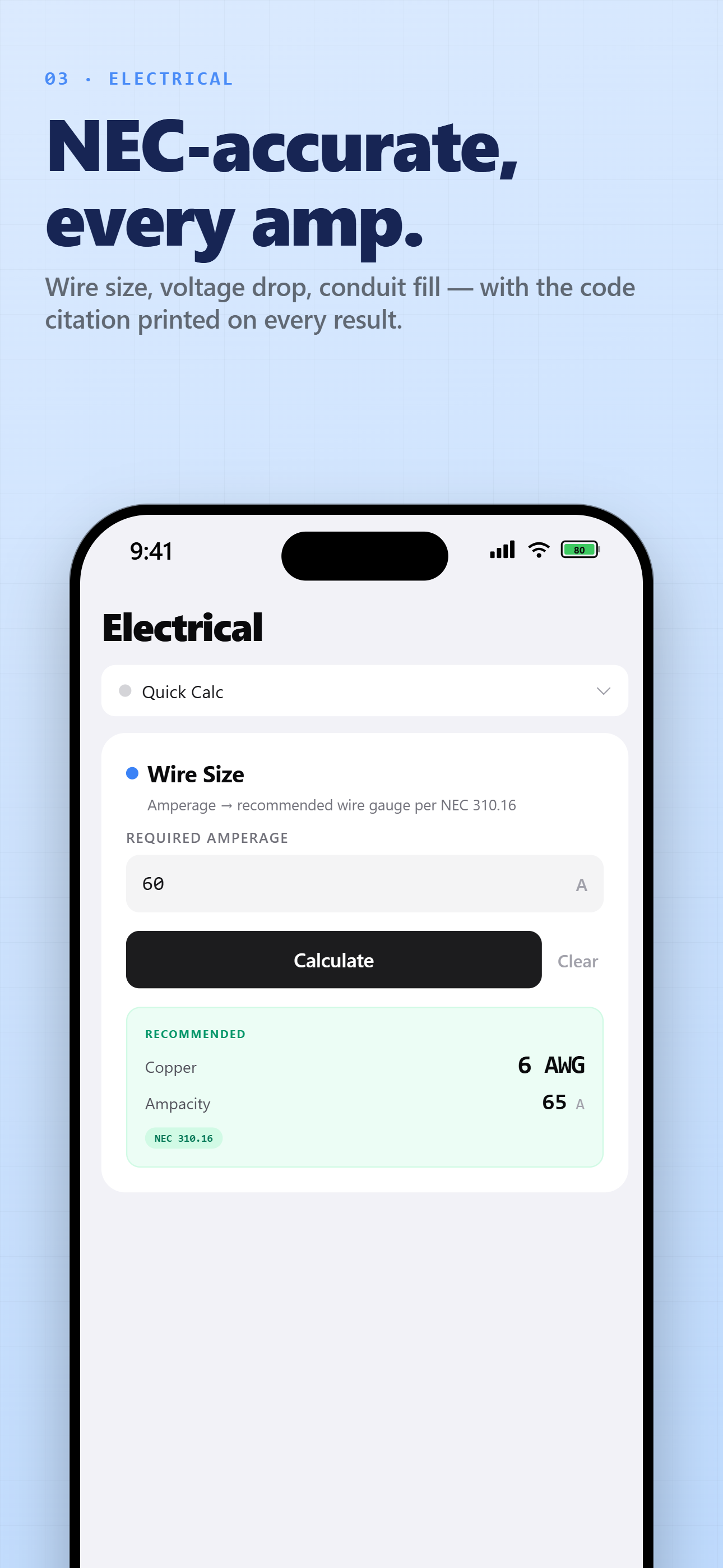
CalcRig’s wire sizing calculator:
- Takes your load amperage, distance, voltage, and conduit type
- Looks up NEC Table 310.15(B)(16) ampacity values
- Applies derating if you specify multiple conductors
- Calculates voltage drop for each candidate wire size
- Returns the minimum code-compliant wire size and the voltage drop percentage
- Shows the NEC reference (table and section number) with every result
The output is a calculation you can hand to an inspector and explain.
Related trade guides: