 CalcRig
· CalcRig Team · 5 min read
Pipe Sizing for Plumbers: Water Supply, Drainage, and Gas Piping
How to size water supply pipes, drain/waste/vent systems, and gas piping correctly — with the UPC and IRC references behind each calculation.
Pipe sizing is one of the most consequential calculations in plumbing. Too small and you get inadequate pressure and velocity. Too large and you waste material, lose velocity in drain lines, and create self-siphonage problems. Here’s how to get it right for the three main systems you’ll encounter.
Water Supply Pipe Sizing
Water supply sizing starts with demand — how much water the system needs to deliver simultaneously. The standard method uses Water Supply Fixture Units (WSFU) from UPC Table 610.3 or IRC Table P2903.6.
Step 1: Count Fixture Units
Each fixture has an assigned WSFU value:
| Fixture | WSFU (Cold + Hot) | WSFU (Cold Only) |
|---|---|---|
| Toilet (flush valve) | 6 | 6 |
| Toilet (tank) | 2.5 | 2.5 |
| Bathtub | 2 | 1 |
| Shower | 2 | 1.5 |
| Kitchen sink | 1.5 | 1 |
| Lavatory (bathroom sink) | 1 | 0.75 |
| Clothes washer | 2 | 2 |
| Dishwasher | 1.5 | — |
| Hose bibb | 2.5 | 2.5 |
Add up the total WSFU for all fixtures served by a branch or the main.
Step 2: Convert WSFU to GPM
UPC Table 610.2 and IRC Table P2903.6(1) provide demand in GPM based on total WSFU. The relationship is not linear — it accounts for the probability that all fixtures won’t run simultaneously.
Approximate conversion (use code tables for final sizing):
- 5 WSFU ≈ 9 GPM
- 10 WSFU ≈ 14 GPM
- 20 WSFU ≈ 18 GPM
- 40 WSFU ≈ 23 GPM
Step 3: Size the Pipe
Given GPM demand and an acceptable velocity (5–8 FPS for supply, 4 FPS max for hot water branches to reduce erosion), find the minimum pipe size from a friction loss chart or the Hazen-Williams formula:
V = 0.4085 × C × D^0.63 × S^0.54Where:
- V = velocity (FPS)
- C = Hazen-Williams coefficient (140 for copper, 150 for PEX)
- D = pipe inside diameter (inches)
- S = slope of energy grade line (head loss per foot of pipe)
In practice: for residential supply mains up to 50 feet, 3/4” copper handles up to about 15 GPM at acceptable velocity. For longer runs or higher demand, move to 1”.
Pressure Drop Check
Always verify that pressure remains adequate at the most remote fixture. Rule of thumb: 40 PSI minimum at any fixture, 80 PSI maximum.
Pressure loss sources:
- Friction loss in straight pipe (use tables or Hazen-Williams)
- Elevation change (0.433 PSI per foot of rise)
- Fittings (use equivalent length method: add 50% to straight-run length for typical residential)
- Pressure regulators, water heaters, and filter housings (specified by manufacturer)
If street pressure is 60 PSI and a shower on the second floor needs 40 PSI minimum, you have 20 PSI to work with for friction and elevation losses.
Drain, Waste, and Vent Sizing (DWV)
DWV sizing uses Drainage Fixture Units (DFU) from UPC Table 702.1 or IRC Table P3004.1.
Common DFU Values
| Fixture | DFU |
|---|---|
| Toilet | 4 |
| Bathtub | 2 |
| Shower | 2 |
| Kitchen sink | 2 |
| Lavatory | 1 |
| Clothes washer standpipe | 2 |
| Dishwasher | 2 |
| Floor drain | 2 |
Horizontal Branch Sizing (UPC Table 703.2)
| Pipe Size | Max DFU (horizontal branch) | Max DFU (building drain, 1/4” slope) |
|---|---|---|
| 1-1/2” | 3 | — |
| 2” | 6 | 21 |
| 2-1/2” | 12 | — |
| 3” | 20 | 42 |
| 4” | 160 | 216 |
Critical rule: Toilets require a minimum 3” drain. You cannot run a toilet on a 2” line.
Slope Matters
Horizontal drains must maintain adequate velocity to carry solids. UPC and IRC specify:
- 1/4” per foot slope for drains 3” and smaller (most common)
- 1/8” per foot slope acceptable for 4” and larger
Too little slope: solids settle, clogs develop. Too much slope: liquid runs ahead of solids, same result.
For a 10-foot horizontal run at 1/4”/ft: total drop = 2.5”. If the upstream end is at 6” above floor, the downstream end is at 3.5”. Check you have clearance for the P-trap and stub-out.
Vent Sizing
Vents prevent siphonage and allow air into the drainage system. Individual vents are typically the same size as the drain they serve or one size smaller (minimum 1-1/4”).
Stack venting (one vent serving multiple fixtures) requires careful sizing — refer to UPC Table 904.1.
Gas Piping Sizing
Gas pipe sizing uses either pressure drop tables (from NFPA 54 / ANSI Z223.1) or the longest length method.
Step 1: Calculate Total BTU Demand
Add up the BTU/hr input ratings for all gas appliances:
| Appliance | Typical BTU/hr Input |
|---|---|
| Range (4 burners + oven) | 65,000 |
| Water heater (residential) | 40,000–75,000 |
| Furnace (100k BTU output) | ~120,000 input |
| Gas dryer | 20,000–35,000 |
| Gas fireplace (insert) | 20,000–60,000 |
Step 2: Find the Longest Run
Measure from the gas meter to the most remote appliance (not the highest BTU — the farthest away). This is the critical path.
Step 3: Size from NFPA 54 Tables
NFPA 54 Table 6.2 (natural gas, 0.5 PSI, 0.5 in. wg pressure drop, specific gravity 0.6) gives maximum capacity in BTU/hr for schedule 40 iron pipe:
| Pipe Size | 20 ft | 40 ft | 60 ft | 80 ft | 100 ft |
|---|---|---|---|---|---|
| 1/2” | 175,000 | 119,000 | 95,000 | 81,000 | 72,000 |
| 3/4” | 360,000 | 248,000 | 198,000 | 170,000 | 151,000 |
| 1” | 670,000 | 463,000 | 371,000 | 318,000 | 283,000 |
Example: 60 feet to the most remote appliance, total demand 200,000 BTU/hr. At 60 ft, 3/4” handles 198,000 — just under. Use 1”.
Then size each branch independently based on its own length and the appliances it serves.
Key rules
- CSST (corrugated stainless steel tubing) requires manufacturer-specific sizing tables
- Pressure drop in connectors matters — add equivalent lengths for each fitting
- Check local amendments — some jurisdictions use different pressure drop allowances
How CalcRig Handles This
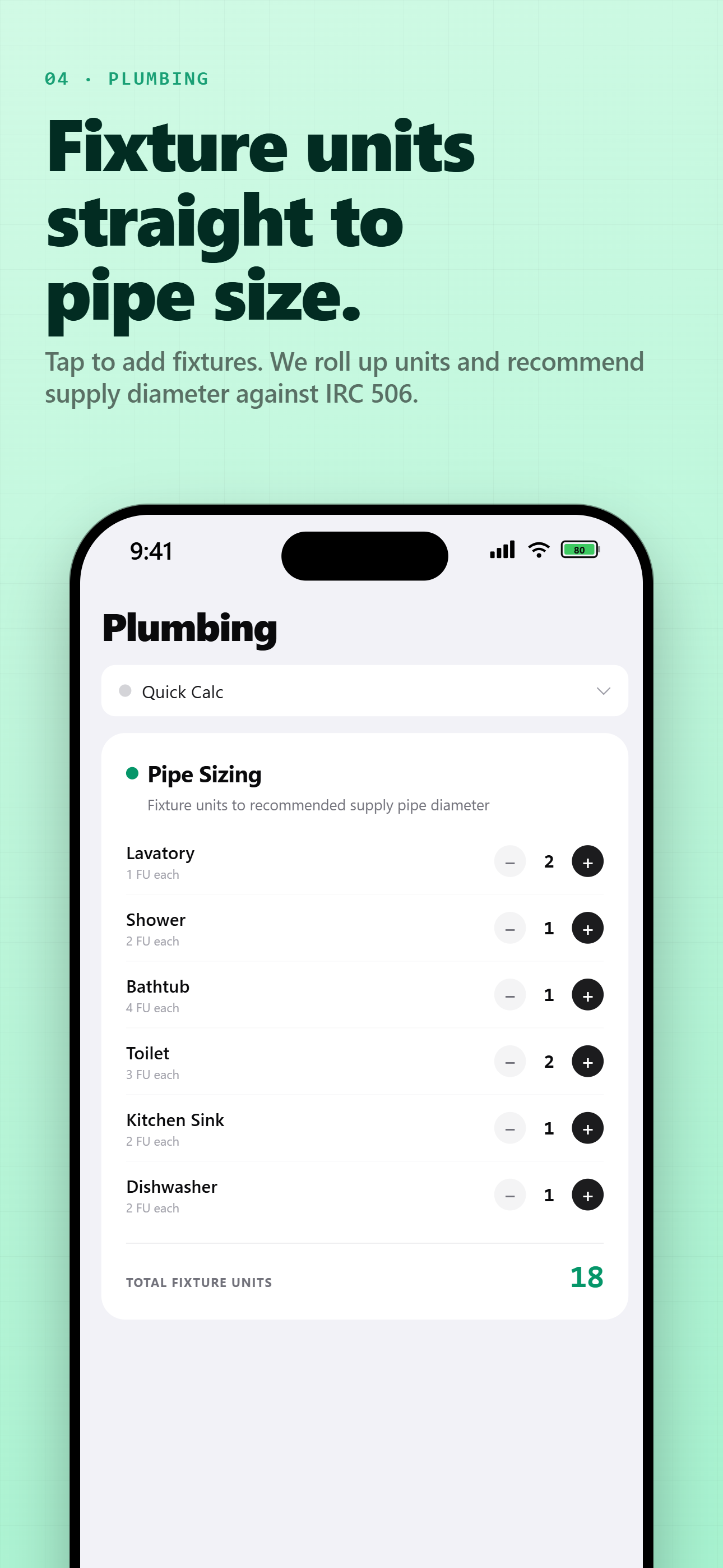
CalcRig’s plumbing calculators automate these lookups:
- Pipe sizing: Enter WSFU count, pipe material, and available pressure — get minimum pipe diameter and pressure drop
- Drainage sizing: Enter DFU count and pipe slope — get minimum drain size per UPC/IRC tables
- Flow rate: Calculate GPM from pipe size, pressure, and material
- Water pressure: Calculate pressure at any point given static pressure, elevation change, and pipe length
Every result cites the UPC or IRC table used so you can verify independently.
Related trade guides: